Monotone Bee: A Boutique Sweatshirt Embroidery Review
First Impressions: Quiet Confidence, Not Quiet Design
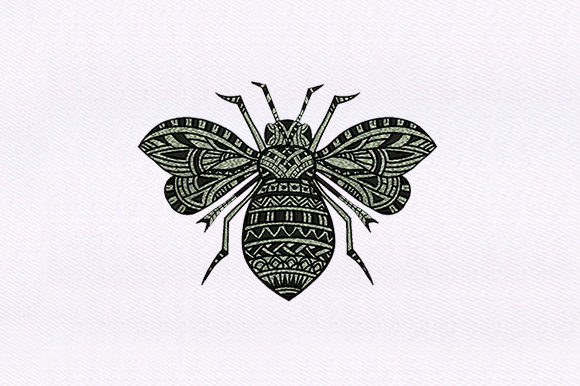
As a designer who’s stitched hundreds of boutique apparel pieces—from linen tees to heavyweight French terry hoodies—I opened Monotone Bee expecting minimalism. What I found was something sharper: intentional restraint with subtle visual weight. It reads as a mandala at a glance—not floral or geometric in the traditional sense, but built from concentric, interlocking curves that echo bee anatomy and sacred symmetry. The monotone treatment isn’t flat; it’s dimensional through stitch direction and density shifts. On screen, it feels calm. In thread? It hums.
How Monotone Bee Lives on Real Sweatshirts
This isn’t a design that shouts—it leans in. That makes it ideal for small clothing brands building quiet authority. On a natural oat or heather charcoal sweatshirt, Monotone Bee reads as elevated basics—think “thoughtful detail, not decoration.” On deep navy or charcoal melange fabric, the contrast relies entirely on thread sheen and stitch texture, not color pop. That’s where its strength lies: it doesn’t need brightness to command attention.
Pastel sweatshirts—dusty rose, sage, sky blue—let the design breathe softly. It avoids cutesy without slipping into austerity. And on oversized hoodies? Perfect. The mandala structure holds proportion well at 3.5"–4.25", scaling gracefully across chest placement without crowding seams or distorting on curved hoods.
For seasonal collections, Monotone Bee works double duty: as a chest emblem on cozy fleece-lined pullovers, or reversed as a subtle sleeve accent (rotate 90°, reduce to 2.25") for layered styling shots. It also translates beautifully to back-of-hoodie placements—centered above the neckline, where its radial balance anchors the garment visually.
Design Personality: Minimalist Mandala, Not Minimal Effort
Let’s name it: Monotone Bee is feminine without florals, playful without whimsy, decorative without clutter. It’s got the grounded warmth of a rustic brand—but refined enough for modern retail. There’s no cartoon bee, no honeycomb grid, no buzzing energy. Instead, there’s rhythm, repetition, and reverence for craft. That’s gold for Etsy sellers and handmade product listings aiming for “curated,” not “craft fair.”
Thread Colors & Contrast: Less Is Truly More
Because it’s monotone, thread choice becomes your secret branding tool. A matte ecru on cream fleece says “slow fashion.” A high-sheen charcoal on black French terry says “quiet luxury.” Avoid overly saturated blacks—they can flatten the subtle layering. Stick to tonal variations: graphite, slate, warm taupe, or soft ivory. Always test stitch on your exact fabric blend before bulk hooping.
Stitch Density & Fabric Reality Check
Given its mandala nature and likely moderate fill areas, Monotone Bee should sit comfortably on midweight to heavyweight sweatshirt knits—but verify stitch density before production. Overly dense fills on plush fleece can cause puckering or stiffness. Under-dense fills risk “ghosting” on dark fabrics. If your embroidery software allows, preview the stitch map: look for balanced satin borders, smooth fill transitions, and clean jump stitches. A well-built machine embroidery design hides complexity behind polish.
Stabilizer & Hoop Strategy
For commercial embroidery on sweatshirts, medium-weight cutaway stabilizer is non-negotiable—and Monotone Bee’s clean lines demand it. Its symmetry won’t forgive shifting. Use a hoop size that fully contains the design with at least ½" margin; don’t stretch to fit. Oversized hoodies often require re-hooping for back placements—plan for consistent registration. And yes, always baste first. That tiny pause saves hours of rework.
Commercial Readiness: Does Monotone Bee Earn Its Place?
Absolutely—if treated with intention. This isn’t a “drop-in-and-stitch” file for beginners. It’s a digital embroidery file that rewards thoughtful execution. When stitched cleanly on premium fabric, it elevates perceived value instantly. Customers notice craftsmanship before they read the label. That builds trust—especially for small shop products where every detail signals care.
For boutique brands, Monotone Bee strengthens visual recognition. Repeat it across your collection—chest, sleeve, back—and it becomes your quiet signature. No logo needed. Just one consistent, confident motif. That cohesion reads as professional, not repetitive. And for Etsy sellers? It performs exceptionally in lifestyle photography: soft light catches the satin sheen, mockup previews highlight its scalability, and customers imagine it on *their* favorite hoodie.
Practical Notes Before You Stitch
- File formats matter: Monotone Bee ships in 15 industry-standard formats—including PES, DST, VP3, and JEF—so compatibility with most commercial and home machines is covered. Confirm your machine’s native format before importing.
- Hoop size isn’t listed—check your files. Mandala-style designs like this often fall between 3.75" and 4.5". Know your limits before digitizing adjustments.
- Washing durability hinges on execution. Proper stabilizer + correct tension + quality thread = wash-after-wash integrity. Don’t skip the rinse test on a sample.
- Small-size readability? At 2.5", fine details may blur on textured fleece. Stick to 3" minimum for chest placement unless using ultra-smooth cotton-blend sweatshirts.
- Licensing terms aren’t specified here. Verify usage rights—especially if planning resale on custom apparel or white-label merchandise.
Final Thought: Monotone Bee Is a Brand Whisperer
In a market flooded with loud logos and trend-chasing motifs, Monotone Bee offers something rarer: resonance. It doesn’t chase attention—it earns it. For embroidery shops stitching for local boutiques, for Etsy sellers building a cohesive line, for handmade business owners investing in lasting design assets—this is the kind of embroidery file that turns a sweatshirt into a statement, and a customer into a repeat buyer. It’s not just stitched on fabric. It’s stitched into identity.