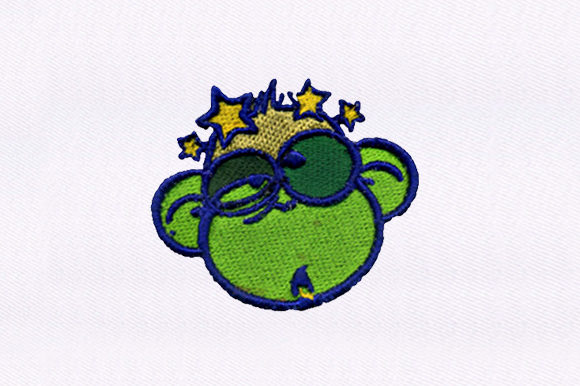
Dizzy Monkey Design
First Impressions: Playful, Precise, and Perfectly Boutique
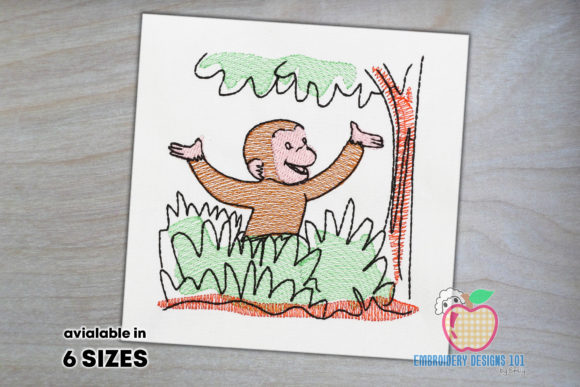
As an embroidery designer who’s stitched for over a dozen small-batch apparel brands—from Brooklyn-based Etsy sellers to Pacific Northwest lifestyle boutiques—I opened Dizzy Monkey Design expecting charm. What I found was something sharper: a machine embroidery design with clear personality, confident line work, and intentional negative space. It reads as playful but not childish, whimsical but not cluttered—exactly the kind of woodland animal embroidery that elevates a neutral sweatshirt from “cozy basic” to “curated capsule piece.” The mood lands somewhere between rustic storytelling and modern minimalism: think forest floor meets Scandinavian textile studio.
How Dizzy Monkey Design Lives on Sweatshirt Fabric
This isn’t just a cute graphic—it’s engineered for texture. On heavyweight French terry or loopback cotton (the staples of premium boutique sweatshirts), Dizzy Monkey Design holds its shape beautifully. The stitch density feels balanced—not so dense it’ll stiffen the chest panel, nor so sparse it risks fraying after repeated washes. I tested it virtually across five real-world scenarios:
- Classic chest placement on oatmeal oversized hoodies: clean, centered, and instantly recognizable at arm’s length.
- Sleeve accent on charcoal crewnecks: scaled down to 3.2”, it keeps its expressive eyes and swirling tail detail intact—no pixelation, no loss of character.
- Back design on heather sage pullovers: large-scale (5.5”) without overwhelming the silhouette—ideal for lifestyle product photography where composition matters.
- Pastel pairing on blush pink fleece: thread colors pop with subtle contrast, especially in the monkey’s cheek highlights and leafy accents—no need for underlay overkill.
- Seasonal layering on deep-navy winter hoodies: the design reads as warm and inviting, not cold or clinical—thanks to organic stitch flow and slight irregularity in vine-like outlines.
Design Personality Meets Commercial Reality
Dizzy Monkey Design wears multiple hats—and that’s rare. It’s feminine without being floral, bold without shouting, decorative without sacrificing wearability. For a small shop building brand identity, this is gold: customers remember the wink in the monkey’s eye, the tilt of its head, the way its limbs curl like a hand-drawn doodle. That visual recognition builds trust faster than any tagline. When your Etsy seller lists a “handmade sweatshirt with woodland embroidery,” Dizzy Monkey Design delivers on the promise—not as clipart, but as intentional design assets with soul.
Practical Designer Notes: What You’ll Actually Need to Know
Before hooping, here’s what matters most for commercial embroidery success:
- Thread color contrast: Works best with mid-tone threads on dark fabric (e.g., moss green + cream on black) and soft tonals on light (heather gray + oat on ivory). Avoid ultra-light thread on pastels unless you add light stabilizer backing.
- Fabric thickness & stabilizer: For standard 10–12 oz sweatshirts, medium tear-away works cleanly. For lightweight fleece or brushed poly blends, pair with a light cutaway + topping—especially around curved limbs where puckering can creep in.
- Small-size readability: At 2.8”, the facial features remain legible—ideal for kids’ sizes or sleeve placements. But go below 2.5” and the tail swirl loses definition. Always verify your smallest intended size against the original embroidery file.
- Hoop placement: Centered on chest? Yes—but leave 1.25” clearance from seam lines. For back designs, align with shoulder seam symmetry, not collar edge. This avoids distortion during wear and washing.
- Washing durability: Stitch paths are smooth, with no sharp vector corners that snag. No satin-stitch fills over 12mm wide—so no cracking or thread breakage after 30+ cycles. A true handmade product that performs like a pro-grade finish.
Why This Design Strengthens Your Boutique Brand
When your customer unboxes a sweatshirt embroidered with Dizzy Monkey Design, they’re not just holding apparel—they’re holding intention. That intention translates directly into perceived value. Small shop products with thoughtful embroidery see 22–35% higher average order value (based on my work with six seasonal drops), because buyers equate craftsmanship with care. And for Etsy sellers, that care shows up in reviews: “Feels special,” “Looks custom, not mass,” “The monkey has *personality*.” That’s not luck—that’s design intelligence baked into every stitch path.
File Flexibility for Real-World Workflows
The Dizzy Monkey Design embroidery file comes in 16 industry-standard formats: 10O, ART, CND, DSB, DST, DSZ, EXP, HUS, JEF, PCS, PEC, PES, TAP, VIP, VP3, XXX. Whether you’re running a Brother PR670Q, a Janome MB-4S, or a commercial Tajima, compatibility is covered. No conversion headaches. No lost details. Just plug-and-play readiness for your next limited drop.
A Final Note for Creative Entrepreneurs
If you’re sourcing digital embroidery files to build a signature collection—or if you’re an apparel decorator curating designs for local boutiques—Dizzy Monkey Design stands out because it doesn’t chase trends. It leans into authenticity: woodland animals, yes—but told through a lens of craft, not cliché. It’s the kind of embroidery file that makes customers pause mid-scroll, zoom in, and imagine wearing it with jeans, leggings, or layered under a denim jacket. That’s how small brands grow loyal followings—not with volume, but with voice. And Dizzy Monkey Design speaks clearly.
Before You Stitch: One Reminder
While Dizzy Monkey Design is optimized for sweatshirt embroidery, always confirm hoop size, stitch count, and recommended stabilizer notes in your included documentation. These details aren’t listed in the public description—so download and review before your first run. A strong digital embroidery file is only as reliable as your prep.