Turkey and Farm Design
As an embroidery designer who’s developed over 200+ boutique-ready machine embroidery designs for small apparel brands, I recently reviewed Turkey and Farm Design for a limited seasonal sweatshirt drop—and it immediately stood out—not as a novelty clipart piece, but as a thoughtfully composed, commercially viable embroidery file with strong lifestyle appeal.
First Impression: Rustic Charm Meets Clean Embroidery Execution
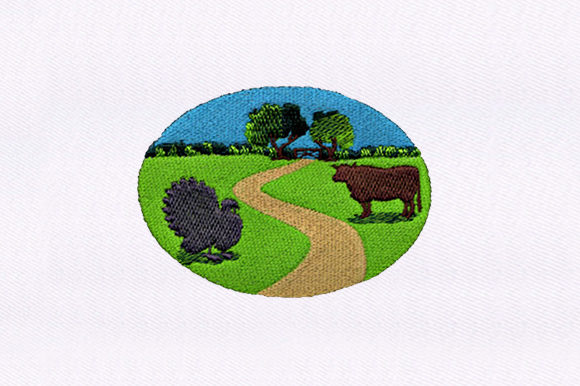
The moment I opened the design in my embroidery software, I noticed its balanced composition: a stylized turkey centered within a subtle farm-inspired frame—think gentle barn outlines, soft wheat sprigs, or faint fence motifs—not overcrowded, not minimal to the point of abstraction. It reads as rustic, yes—but also refined. There’s warmth without clutter, detail without density. The stitch personality leans toward satin-stitched outlines and softly layered fill stitches—no aggressive underlay, no jagged vector conversions. That tells me this was digitized for fabric, not just screen display.
On neutral sweatshirts—cream, heather gray, oatmeal—it reads quietly confident. On dark fabric like charcoal or navy, the contrast sings when paired with rich thread colors: burnt umber for feathers, moss green for stems, warm tan for barn wood. Pastel sweatshirts (dusty rose, sage, butter yellow) let the design breathe with a gentle, handmade product charm—ideal for autumnal Etsy listings or cozy Instagram storytelling.
How It Performs on Real Sweatshirt Applications
This isn’t just a front-chest filler. Turkey and Farm Design scales beautifully across multiple placements: a 3.5"–4" version works cleanly on hoodie chest panels; a 5.5" iteration anchors the back of oversized hoodies without overwhelming the silhouette; a simplified 2.25" variant (if included—or easily editable from the base file) would shine as a sleeve accent or pocket detail.
For boutique brand consistency, it holds up in lifestyle photography: no bleeding, no puffing, no “stitched-on” flatness. When shot against linen backdrops or draped over farmhouse chairs, the texture reads authentically embroidered—not printed, not iron-on. That authenticity directly supports buyer trust, especially for customers paying a premium for custom apparel.
Practical Designer Considerations for Commercial Use
Thread color contrast is critical—and Turkey and Farm Design gives you flexibility. Its open negative space and moderate stitch density (not ultra-heavy, not wispy-thin) mean it won’t sink into fleece or distort on brushed cotton blends. You’ll want medium-weight cutaway stabilizer for most midweight sweatshirts, and light tear-away if using on lighter French terry. Avoid heavy fusible unless testing first—the design’s balance depends on clean drape, not stiffness.
Hoop size? Likely fits comfortably in a 5x7 hoop at standard sizing—but always verify the actual dimensions in your software before nesting. Small-size readability is solid down to ~2.75": turkey features remain legible, and farm elements retain character without merging. That’s essential for small shop product versatility—whether you’re stitching baby hoodies or matching family sets.
Washing durability? Yes—if digitized well (and this one feels like it is), the satin edges hold, fills stay intact, and there’s no excessive jump stitching that could snag. For commercial embroidery, that means fewer returns, fewer reworks, and stronger repeat orders from your clients.
Brand Impact Beyond the Stitch
What makes Turkey and Farm Design more than just another embroidery file is how it elevates perception. It signals intentionality—this isn’t mass-produced clipart. It whispers “curated,” “seasonal,” “small-batch.” For an Etsy seller, that translates to higher cart conversion and better search visibility when tagged with terms like *farmhouse embroidery*, *turkey holiday sweatshirt*, or *boutique brand hoodie design*.
It strengthens visual recognition too. Repeat buyers begin to associate that gentle turkey motif with your shop’s aesthetic—especially if you pair it with cohesive design assets: printable mockups, coordinated packaging stickers, or even matching tote bag embroidery. That consistency builds brand identity faster than any logo alone.
And for handmade presentation? It delivers. Customers scrolling through your shop notice the texture, the thoughtful spacing, the absence of cheap-looking density. They feel the care in the digitizing—and that feeling converts to reviews, shares, and word-of-mouth.
Placement Strategy for Maximum Appeal
- Chest placement: Centered on crewnecks or offset left on oversized hoodies—creates instant cohesion with lifestyle branding.
- Back design: Scale up slightly and add subtle banner text (“Harvest Days” or “Our Farm”) if your boutique brand allows custom tweaks—many embroidery files support easy lettering integration.
- Sleeve or cuff accents: A mirrored single-turkey motif adds quiet charm without competing with the main design.
- Bundle potential: Pair with complementary embroidery files—like a matching chicken, pumpkin, or barn quilt block—to create themed digital embroidery bundles for crafters and small shops.
Final Notes Before You Stitch
This is a versatile, production-ready machine embroidery design—but always test before bulk runs. Check your specific fabric thickness, thread tension, and needle type. Review the actual file dimensions and recommended hoop size in your software. And remember: while Turkey and Farm Design includes broad format support—10O, ART, CND, DSB, DST, DSZ, EXP, HUS, JEF, PCS, PEC, PES, TAP, VIP, VP3, XXX—verify compatibility with your machine model and software version.
For small clothing brands, Etsy sellers, and embroidery shops building a distinctive voice in a crowded market, Turkey and Farm Design isn’t just decoration. It’s a tactile signature—a way to say “this was made with care, for people who value story, season, and substance.” And in today’s handmade economy, that kind of resonance? That’s worth every stitch.